Art Open Data

  • Exploring Tate Art Open Data 0

    Why visualise the Tate’s collection dataset?

    The Tate is the UK’s largest art institution. The free and open release of Tate’s collection data shows just how far open data has come in the last decade, and makes a major resource available for study. This resource allows us to follow two lines of investigation.

    The first is into the history of art, using the Tate’s collection as a model of art in general, particularly of British art. The Tate’s collection data describes the form, content, attribution and dates of a sample of art from the past several hundred years. This is a history of art, and as long as we place it in its historical context it can be a useful one.

    The second is institutional critique, to analyse the Tate’s collection and contrast it with other collections and with other models of the history of art (verbal, data-based or otherwise). Rather than allowing or controlling for the historical context of the data this makes recovering and examining that context the focus.

    It’s possible to succeed or fail at each, and neither requires taking the claims of Museums to represent history or of data to represent reality at face value or in a vacuum. Data visualisation and statistical analysis are ways of dealing with datasets that would take a human reader many years to examine. They are forms of rhetoric, but they are also useful tools.

    With suitable modesty of aims and suitable reflection on the historical and political contexts which have given rise to our tools and materials, let us begin…

  • Exploring Tate Art Open Data 2

    This is the second in a series of posts examining Tate’s excellent collection dataset. You can read the first part here.The R and R Markdown code for this series is available at https://github.com/rheaplex/tate-data-r/ .

    As before, let’s get started by loading the data.

    source("../r/load_tate_data.r")
    

    Movement Artwork Counts

    Next let’s load some code to visualize the number of artworks in the collection categorized as being produced by a particular movement each year.

    source("../r/movement_artwork_counts.r")
    

    You can see the code in the Git repository above. It loads the Tate collection data files and declares some functions that we can use to plot movement artwork counts.

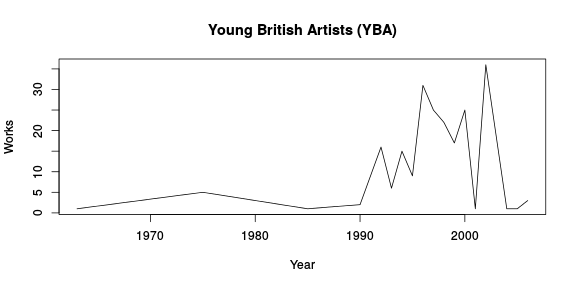
    We can plot the number of artworks from a given movement, for example the Young British Artists (YBAs):

    plotMovementFrequency("Young British Artists (YBA)")
    

    YBAs
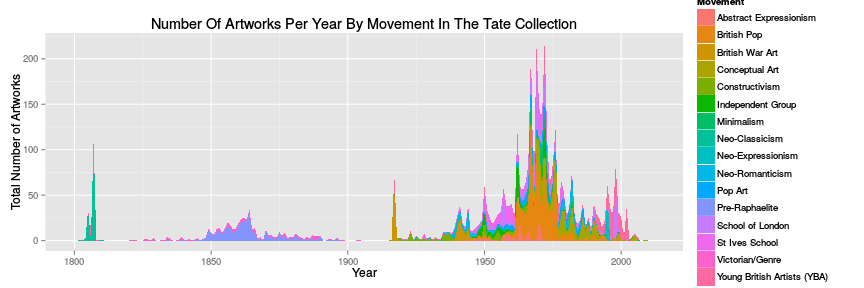
    Or we can plot the combined counts for multiple movements, for example those since 1800:

    plotArtworkCountsByYear()
    

    Movements Since 1800
    These figures are available as PDFs in the Git repository.

    Movement Durations

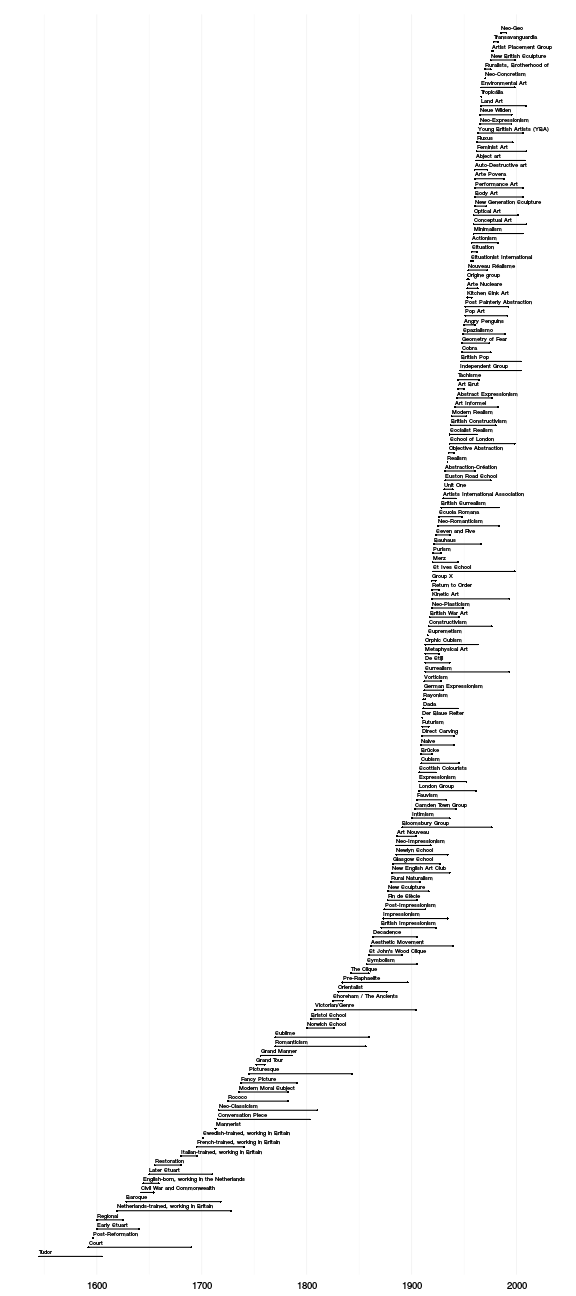
    When did a movement start and end, and how long did it last? We can plot this for movements as defined by the date of production of the artworks labelled as being part of that movement in the Tate collection.

    source("../r/movement_durations.r")
    

    First by movement name:

    plotMovementDurations(movement.durations.alpha, movement.order.alpha)
    

    Movements By Name

    And then by movement start date:

    plotMovementDurations(movement.durations.from, movement.order.from)
    

    Movements By Start Date

    These figures are also available as PDFs in the Git repository.

    Movement Influences

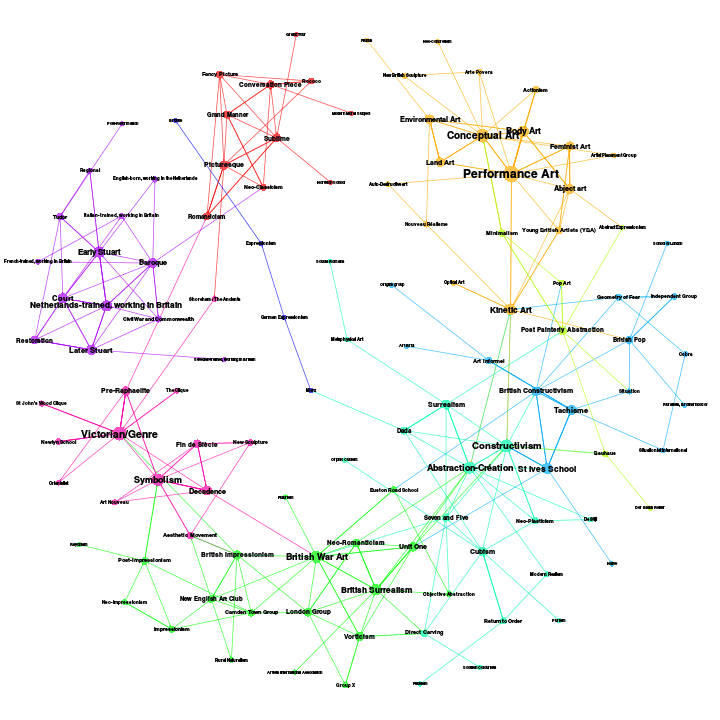
    We can use artists who are in two or more movements as links between movements, constructing a network graph of social connections between movements.
    Like the Wikipedia data-based update of Alfred Barr’s handmade diagram for the MoMA Cubism & Abstract Art exhibition of 1936 Collectivizing The Barr Model we can extract a family tree (or Rhizome) of influence between art movements and otherwise use network analysis methods to study the social network of art movements:

    plotMovementArtistLinks()
    

    Movements Connected By ArtistsAgain, this figure is also available as PDFs in the Git repository.

    Conclusions

    As you can see some of these graphics work better as posters or large-scale PDFs than as bitmaps. There’s much that could be done with curve fitting and comparison of movement artwork counts. And all the techniques of social network analysis can be applied to the graph of artists and movements.

    Next we’ll look at artwork genres, which are not explicitly labelled in the collection dataset.

  • Exploring Tate Art Open Data 1

    This is the first in a series of posts examining Tate's excellent collection dataset available at http://www.tate.org.uk/about/our-work/digital/collection-data .

    I've processed that dataset using code for Mongo DB and Node.js available at https://github.com/rheaplex/tate-data/ .

    The R and R Markdown code for this series is available at https://github.com/rheaplex/tate-data-r/ .

    This document has been produced using Knitr. Text in light grey boxes is R code or the output of that code.

    Let's get started by loading the data.

    source("../r/load_tate_data.r")
    

    That file reads the comma separated value (csv) files containing information about the Tate's collection and generates some useful extra tables of information. Now we have everything in memory we can start examining the collection data.

    Artists

    What can we find out about artists in general?

    summary(artist[c("name", "gender", "dates", "yearOfBirth", "yearOfDeath", "placeOfBirth", 
        "placeOfDeath")])
    
                  name         gender                 dates     
     Bateman, James :   2         : 112   dates not known:  59  
     Doyle, John    :   2   Female: 521   born 1967      :  42  
     Hone, Nathaniel:   2   Male  :2894   born 1936      :  38  
     Peri, Peter    :   2                 born 1930      :  36  
     Stokes, Adrian :   2                 born 1938      :  36  
     Wilson, Richard:   2                 born 1941      :  34  
     (Other)        :3515                 (Other)        :3282  
      yearOfBirth    yearOfDeath                      placeOfBirth 
     Min.   :1497   Min.   :1543                            : 491  
     1st Qu.:1855   1st Qu.:1874   London, United Kingdom   : 446  
     Median :1910   Median :1944   Paris, France            :  57  
     Mean   :1887   Mean   :1920   Edinburgh, United Kingdom:  47  
     3rd Qu.:1941   3rd Qu.:1982   New York, United States  :  43  
     Max.   :2004   Max.   :2013   Glasgow, United Kingdom  :  35  
     NA's   :57     NA's   :1309   (Other)                  :2408  
                        placeOfDeath 
                              :2079  
     London, United Kingdom   : 442  
     Paris, France            :  82  
     New York, United States  :  45  
     Roma, Italia             :  22  
     Edinburgh, United Kingdom:  18  
     (Other)                  : 839  
    

    There are more male than female artists, and the yBA and Pop generations lead the births.

    Depending on whether we treat place of birth or place of death as more representative, London and Paris are ahead of New York or Edinburgh.

    We can smooth out the birth and death dates by grouping them by decade or century.

    summary(artist.birth.decade)
    
       Min. 1st Qu.  Median    Mean 3rd Qu.    Max.    NA's 
       1500    1860    1910    1890    1940    2000      57 
    
    summary(artist.death.decade)
    
       Min. 1st Qu.  Median    Mean 3rd Qu.    Max.    NA's 
       1540    1870    1940    1920    1980    2010    1309 
    
    sort(table(artist.birth.decade), decreasing = TRUE)
    
    artist.birth.decade
    1940 1930 1960 1920 1970 1900 1950 1910 1880 1890 1860 1870 1840 1780 1800 
     363  285  256  255  222  217  197  186  153  151  136  123   77   72   69 
    1850 1820 1830 1980 1790 1810 1760 1770 1740 1750 1730 1700 1720 1710 1630 
      69   67   65   58   57   49   45   44   42   38   31   27   15   13   12 
    1680 1640 1660 1600 1580 1590 1610 1650 1690 1620 1990 2000 1500 1530 1540 
      10    9    8    6    5    4    4    4    4    3    3    3    2    2    2 
    1550 1560 1670 1570 
       2    2    2    1 
    
    
    summary(artist.birth.century)
    
       Min. 1st Qu.  Median    Mean 3rd Qu.    Max.    NA's 
       1500    1900    1900    1890    1900    2000      57 
    
    summary(artist.death.century)
    
       Min. 1st Qu.  Median    Mean 3rd Qu.    Max.    NA's 
       1500    1900    1900    1920    2000    2000    1309 
    
    sort(table(artist.death.decade), decreasing = TRUE)
    
    artist.death.decade
    2000 1980 1960 1990 1970 1940 2010 1920 1930 1950 1900 1910 1840 1860 1880 
     224  191  172  157  140  131  112  102   92   89   80   69   59   59   54 
    1850 1870 1890 1820 1830 1800 1810 1780 1790 1700 1760 1770 1750 1720 1730 
      53   49   49   46   44   42   40   24   23   15   14   12   10    7    7 
    1740 1680 1710 1640 1690 1620 1650 1660 1570 1670 1600 1630 1540 
       7    6    6    5    5    4    4    4    3    3    2    2    1 
    

    That's quite a different result from that suggested by the yearly results. Decade-wise, birth percentiles are clustered around the turn of the 20th century, deaths around the second world war. But the largest number of births are in the 1930s/1940s with the 1960s coming in second. The deaths look like they reflect the distribution of births, although it would be useful to confirm this statistically.

    The maximim birth being in the 2000s doesn't mean that the Tate is collecting child artists, the birth data also includes the years that artist groups were started.

    How well is gender represented in the collection?

    table(artist.birth.decade, artist$gender)
    
    
    artist.birth.decade     Female Male
                   1500   1      0    1
                   1530   1      0    1
                   1540   0      0    2
                   1550   0      0    2
                   1560   0      0    2
                   1570   0      0    1
                   1580   0      0    5
                   1590   1      0    3
                   1600   3      0    3
                   1610   1      0    3
                   1620   0      0    3
                   1630   0      1   11
                   1640   0      0    9
                   1650   0      0    4
                   1660   0      0    8
                   1670   1      0    1
                   1680   0      0   10
                   1690   0      0    4
                   1700   4      1   22
                   1710   0      0   13
                   1720   0      1   14
                   1730   0      0   31
                   1740   1      1   40
                   1750   0      3   35
                   1760   0      1   44
                   1770   0      1   43
                   1780   1      5   66
                   1790   1      0   56
                   1800  10      0   59
                   1810   0      2   47
                   1820   0      1   66
                   1830   1      6   58
                   1840   0      5   72
                   1850   0      2   67
                   1860   1     10  125
                   1870   0     15  108
                   1880   4     23  126
                   1890   4     18  129
                   1900   8     38  171
                   1910   3     37  146
                   1920   2     33  220
                   1930   4     38  243
                   1940  12     62  289
                   1950   2     40  155
                   1960   6     77  173
                   1970   8     70  144
                   1980   3     21   34
                   1990   2      0    1
                   2000   2      0    1
    
    
    table(artist.birth.century, artist$gender)
    
    
    artist.birth.century      Female Male
                    1500    2      0    5
                    1600    5      1   44
                    1700    6      4  157
                    1800   13     24  576
                    1900   39    293 1667
                    2000   22    190  422
    

    The first, unlabelled, column is for artists whose gender is not currently recorded in the data.

    As we saw in the summary, there are more male artists than female artists in the Tate's collection. There is no decade or century in which this trend is reversed. The story is slightly different when we look at artistic movements.

    Movements

    The data for artists includes information on

    
    Error in movements$movement.name : 
      $ operator is invalid for atomic vectors


    artists movements. If we looked at the artwork data there might be more, but we'll stick with the artists for now.

    summary(artist.movements[c("artist.fc", "artist.gender", "movement.era.name", 
        "movement.name")])
    
                           artist.fc   artist.gender
     Ben Nicholson OM           :  6         :  5   
     Dame Barbara Hepworth      :  5   Female: 27   
     Gilbert Soest              :  5   Male  :324   
     Joseph Beuys               :  5                
     Sir Peter Lely             :  5                
     British School 17th century:  4                
     (Other)                    :326                
                  movement.era.name
     16th and 17th century : 47    
     18th century          : 27    
     19th century          : 63    
     20th century 1900-1945: 95    
     20th century post-1945:124    
    
    
                                     movement.name
     Performance Art                        : 14  
     Conceptual Art                         : 10  
     Netherlands-trained, working in Britain: 10  
     Constructivism                         :  9  
     Body Art                               :  8  
     British Surrealism                     :  8  
     (Other)                                :297  
    
    summary(artist.movements$movement.era.name)
    
     16th and 17th century           18th century           19th century 
                        47                     27                     63 
    20th century 1900-1945 20th century post-1945 
                        95                    124 
    
    summary(artist.movements$movement.name)
    
                             Performance Art 
                                          14 
                              Conceptual Art 
                                          10 
     Netherlands-trained, working in Britain 
                                          10 
                              Constructivism 
                                           9 
                                    Body Art 
                                           8 
                          British Surrealism 
                                           8 
                              St Ives School 
                                           8 
                             Victorian/Genre 
                                           8 
                        Abstraction-Création 
                                           7 
                             British War Art 
                                           7 
                                       Court 
                                           7 
                           Environmental Art 
                                           7 
                                Later Stuart 
                                           7 
                                 Picturesque 
                                           7 
                                  Surrealism 
                                           7 
                                   Symbolism 
                                           7 
                                  Abject art 
                                           6 
                                     Baroque 
                                           6 
                      British Constructivism 
                                           6 
                       British Impressionism 
                                           6 
                                   Decadence 
                                           6 
                              Pre-Raphaelite 
                                           6 
                                    Unit One 
                                           6 
                                Grand Manner 
                                           5 
                                 Kinetic Art 
                                           5 
                                    Land Art 
                                           5 
                                  Minimalism 
                                           5 
                             Neo-Romanticism 
                                           5 
                                    Tachisme 
                                           5 
                                   Vorticism 
                                           5 
                          Aesthetic Movement 
                                           4 
                           Camden Town Group 
                                           4 
                          Conversation Piece 
                                           4 
                                      Cubism 
                                           4 
                                Feminist Art 
                                           4 
                            Geometry of Fear 
                                           4 
                           Neo-Expressionism 
                                           4 
                                 Restoration 
                                           4 
                             Return to Order 
                                           4 
                              Seven and Five 
                                           4 
                                     Sublime 
                                           4 
                                 British Pop 
                                           3 
                  Civil War and Commonwealth 
                                           3 
                                        Dada 
                                           3 
                               Fancy Picture 
                                           3 
                               Fin de Siècle 
                                           3 
                               Impressionism 
                                           3 
                                London Group 
                                           3 
                        New English Art Club 
                                           3 
                          Post-Impressionism 
                                           3 
                                       Tudor 
                                           3 
                 Young British Artists (YBA) 
                                           3 
                                Art Informel 
                                           2 
                                 Art Nouveau 
                                           2 
                        Auto-Destructive art 
                                           2 
                              Direct Carving 
                                           2 
                          Euston Road School 
                                           2 
                              Neo-Classicism 
                                           2 
                              Neo-Plasticism 
                                           2 
                               Newlyn School 
                                           2 
                               New Sculpture 
                                           2 
                                 Optical Art 
                                           2 
                                     Pop Art 
                                           2 
                  Post Painterly Abstraction 
                                           2 
                                    Regional 
                                           2 
                                   Situation 
                                           2 
                  Situationist International 
                                           2 
                      Abstract Expressionism 
                                           1 
                                   Actionism 
                                           1 
                               Arte Nucleare 
                                           1 
                      Artist Placement Group 
                                           1 
           Artists International Association 
                                           1 
                                     Bauhaus 
                                           1 
                                       Cobra 
                                           1 
                            Der Blaue Reiter 
                                           1 
                                    De Stijl 
                                           1 
                                Early Stuart 
                                           1 
    English-born, working in the Netherlands 
                                           1 
                               Expressionism 
                                           1 
                                     Fauvism 
                                           1 
                                      Fluxus 
                                           1 
          French-trained, working in Britain 
                                           1 
                                    Futurism 
                                           1 
                        German Expressionism 
                                           1 
                                  Grand Tour 
                                           1 
                           Independent Group 
                                           1 
         Italian-trained, working in Britain 
                                           1 
                                        Merz 
                                           1 
                            Metaphysical Art 
                                           1 
                        Modern Moral Subject 
                                           1 
                              Modern Realism 
                                           1 
                           Neo-Impressionism 
                                           1 
                                 Neue Wilden 
                                           1 
                       New British Sculpture 
                                           1 
                              Norwich School 
                                           1 
                            Nouveau Réalisme 
                                           1 
                                 Orientalist 
                                           1 
                               Origine group 
                                           1 
                            Post-Reformation 
                                           1 
                                     (Other) 
                                           9 
    

    The artists included in the most movements are some of the grand elders of British 20th Century art. Being in an art movement doesn't improve gender representation.

    The most movements are post-1945. Performance art is more popular than Conceptual art, which is interesting given public discussion of state art funding in the UK. “Netherlands-trained, working in Britain” clearly isn't a movement, as with the birth dates the movement name field doesn't always describe a movement per se.

    Let's break down gender by movement.

    table(artist.movements$movement.era.name, artist.movements$artist.gender)
    
    
                                 Female Male
      16th and 17th century    5      0   42
      18th century             0      0   27
      19th century             0      0   63
      20th century 1900-1945   0      9   86
      20th century post-1945   0     18  106
    
    movement.gender <- table(artist.movements$movement.name, artist.movements$artist.gender)
    movement.gender <- movement.gender[order(movement.gender[, 2], decreasing = TRUE), 
        ]
    movement.gender[1:20, ]
    
    
                                    Female Male
      Performance Art             0      5    9
      Feminist Art                0      4    0
      Abject art                  0      3    3
      Abstraction-Création        0      2    5
      Constructivism              0      2    7
      St Ives School              0      2    6
      Body Art                    0      1    7
      Camden Town Group           0      1    3
      Kinetic Art                 0      1    4
      Minimalism                  0      1    4
      Rayonism                    0      1    0
      Seven and Five              0      1    3
      Surrealism                  0      1    6
      Unit One                    0      1    5
      Young British Artists (YBA) 0      1    2
      Abstract Expressionism      0      0    1
      Actionism                   0      0    1
      Aesthetic Movement          0      0    4
      Arte Nucleare               0      0    1
      Art Informel                0      0    2
    

    Representation improves slightly over time. Unsurprisingly, feminist art has more female than male artists represented. Abject art is a tie, and there are more than half as many female performance artists as male ones.

    Artworks

    There are

    
    Error in eval(expr, envir, enclos) : object 'artwork.title' not found


    artworks in the dataset.

    summary(artwork[c("artist", "title", "dateText")])
    
                                artist                    title      
     Turner, Joseph Mallord William:39389   [title not known]: 3659  
     Jones, George                 : 1046   [blank]          : 3520  
     Moore, Henry, OM, CH          :  623   Blank            : 1995  
     Daniell, William              :  612   [no title]       : 1883  
     Beuys, Joseph                 :  578   Untitled         :  627  
     British (?) School            :  388   Mountains        :  540  
     (Other)                       :26493   (Other)          :56905  
               dateText    
     date not known: 5993  
     1819          : 2908  
     1801          : 1331  
     c.1830–41     : 1194  
     1833          : 1171  
     1831          : 1170  
     (Other)       :55362  
    
    summary(artwork$year)
    
       Min. 1st Qu.  Median    Mean 3rd Qu.    Max.    NA's 
       1540    1820    1830    1870    1950    2010    5397 
    

    JMW Turner has tens of thousands more works in the collection than the next nearest artist. Is this a glitch? No, it's due to the fact that the Tate holds the Turner Bequest of around 30,000 works on paper.

    What are artworks titled? Usually Untitled, or simply no title. “Mountains” appears to be the most popular actual title, although if we stemmed or otherwise abstracted and clustered the titles other popular ones might emerge.

    The most popular years for artworks are in the early 1800s. This, and possibly the titles, are again attributable to Turner. It would probably be productive to remove Turner's works on paper (or more simply just remove all Turner's works) from the dataset and try again, as his presence is clearly skewing the analysis.

    Both artists and artworks have movements. Let's look at how artwork movements differ from artists.

    summary(artwork.movements)
    
       artwork.id    
     Min.   :    22  
     1st Qu.:  6050  
     Median : 11496  
     Mean   : 21962  
     3rd Qu.: 21954  
     Max.   :114918  
    
                                                      artwork.title 
     [no title]                                              : 674  
     [title not known]                                       : 169  
     Untitled                                                : 116  
     Insertions into Ideological Circuits 2: Banknote Project:  54  
     Walking the Dog                                         :  39  
     Exquisite Corpse                                        :  37  
     (Other)                                                 :5894  
          year                   artwork.medium movement.era.id
     Min.   :1545   Screenprint on paper:1301   Min.   :  8    
     1st Qu.:1920   Oil paint on canvas :1113   1st Qu.:290    
     Median :1963   Lithograph on paper : 527   Median :415    
     Mean   :1936   Etching on paper    : 393   Mean   :327    
     3rd Qu.:1973   Graphite on paper   : 205   3rd Qu.:415    
     Max.   :2009   Bronze              : 113   Max.   :415    
     NA's   :303    (Other)             :3331                  
                  movement.era.name  movement.id             movement.name 
     16th and 17th century : 177    Min.   :  293   British Pop     : 846  
     18th century          : 469    1st Qu.:  363   Conceptual Art  : 445  
     19th century          :1004    Median :  433   Pre-Raphaelite  : 405  
     20th century 1900-1945:1156    Mean   : 2421   St Ives School  : 400  
     20th century post-1945:4177    3rd Qu.: 1683   School of London: 373  
                                    Max.   :18626   Neo-Classicism  : 310  
                                                    (Other)         :4204  
    
    summary(artwork.movements$movement.name)[1:20]
    
                    British Pop              Conceptual Art 
                            846                         445 
                 Pre-Raphaelite              St Ives School 
                            405                         400 
               School of London              Neo-Classicism 
                            373                         310 
                        Pop Art Young British Artists (YBA) 
                            246                         226 
              Independent Group              Constructivism 
                            178                         147 
                British War Art                  Minimalism 
                            141                         138 
                Victorian/Genre           Neo-Expressionism 
                            125                         111 
                Neo-Romanticism      Abstract Expressionism 
                            107                         102 
                     Surrealism            Geometry of Fear 
                             96                          84 
                Performance Art          British Surrealism 
                             81                          75 
    
    summary(artwork.movements$movement.era.name)
    
     16th and 17th century           18th century           19th century 
                       177                    469                   1004 
    20th century 1900-1945 20th century post-1945 
                      1156                   4177 
    

    Pop and Pre-Raphaelitism gain in popularity, but Conceptualism and Surrealism are still popular.

    Subjects

    Each artwork is tagged with descriptions of the subjects that it depicts. Subjects have levels, from general to specific, which I've named the category, subcategory and subject. We can group the subjects of artworks by artists and movements to find out what their characteristic subjects were.

    summary(artwork.subjects[c("artwork.title", "artwork.dateText", "category.name", 
        "subcategory.name", "subject.name")])
    
               artwork.title          artwork.dateText       category.name  
     [title not known]: 13992   date not known: 29732   nature      :76796  
     [no title]       :  8146   1819          : 12948   places      :60314  
     Untitled         :  2148   1833          :  5865   architecture:57507  
     Mountains        :   899   1801          :  5023   people      :52820  
     Shipping         :   462   1831          :  4817   objects     :22990  
     Walking the Dog  :   412   1840          :  4498   society     :20032  
     (Other)          :316957   (Other)       :280133   (Other)     :52557  
                          subcategory.name              subject.name   
     landscape                    : 32722   hill              :  9737  
     adults                       : 22048   wooded            :  8223  
     townscapes, man-made features: 21272   man               :  8164  
     seascapes and coasts         : 12202   figure            :  8118  
     water: inland                : 11839   townscape, distant:  7916  
     countries and continents     : 11704   England           :  7661  
     (Other)                      :231229   (Other)           :293197  
    
    summary(artwork.subjects$category.name)[1:20]
    
                     abstraction                 architecture 
                           13304                        57507 
    emotions, concepts and ideas                      history 
                           11583                         1948 
                       interiors         leisure and pastimes 
                            2467                         3446 
          literature and fiction                       nature 
                            2977                        76796 
                         objects                       people 
                           22990                        52820 
                          places          religion and belief 
                           60314                         4376 
                         society   symbols & personifications 
                           20032                         6242 
            work and occupations                         <NA> 
                            6214                           NA 
                            <NA>                         <NA> 
                              NA                           NA 
                            <NA>                         <NA> 
                              NA                           NA 
    
    summary(artwork.subjects$subcategory.name)[1:16]
    
                           landscape                           adults 
                               32722                            22048 
       townscapes, man-made features             seascapes and coasts 
                               21272                            12202 
                       water: inland         countries and continents 
                               11839                            11704 
            UK countries and regions cities, towns, villages (non-UK) 
                               10800                            10160 
                non-representational                 transport: water 
                                9583                             9537 
       actions: postures and motions                      UK counties 
                                9055                             8867 
                            features                         military 
                                8694                             7091 
                    formal qualities    UK cities, towns and villages 
                                6934                             6695 
    
    summary(artwork.subjects$subject.name)[1:20]
    
                  hill             wooded                man 
                  9737               8223               8164 
                figure townscape, distant            England 
                  8118               7916               7661 
                 river              woman           mountain 
                  7549               7303               5932 
                castle             bridge              rocky 
                  5298               3769               3759 
                 group              coast              Italy 
                  3694               3545               3509 
         boat, sailing          townscape             colour 
                  3381               3157               2859 
                   sea              tower 
                  2810               2803 
    

    The summary looks like Turner is skewing the results again. The subjects are mostly English landscape of the early 19th Century. But the categories are led by more non-representional subjects, before the subcategories and subjects return to landscape. People (“adults”, “man”, “woman”) emerge as popular subjects as well, indeed they are the second largest subcategory.

    summary(artist.subjects[c("artist.name", "category.name", "subcategory.name", 
        "subject.name")])
    
                                              artist.name        category.name
     David Lucas                                    :1653   nature      :991  
     Jacques Lipchitz                               : 301   places      :551  
     Colin Lanceley                                 : 181   people      :471  
     Bernard Leach                                  : 104   architecture:345  
     Langlands & Bell (Ben Langlands and Nikki Bell):  78   abstraction :275  
     Linder                                         :  65   objects     :256  
     (Other)                                        :1091   (Other)     :584  
                     subcategory.name    subject.name 
     landscape               : 287    figure   : 157  
     adults                  : 250    England  : 144  
     weather                 : 198    wooded   : 138  
     non-representational    : 186    cloud    :  99  
     UK countries and regions: 151    man      :  84  
     animals: mammals        : 145    geometric:  74  
     (Other)                 :2256    (Other)  :2777  
    
    summary(artist.subjects$category.name)[1:20]
    
                     abstraction                 architecture 
                             275                          345 
    emotions, concepts and ideas                      history 
                             132                           16 
                       interiors         leisure and pastimes 
                              18                           36 
          literature and fiction                       nature 
                              36                          991 
                         objects                       people 
                             256                          471 
                          places          religion and belief 
                             551                           70 
                         society   symbols & personifications 
                             153                           51 
            work and occupations                         <NA> 
                              72                           NA 
                            <NA>                         <NA> 
                              NA                           NA 
                            <NA>                         <NA> 
                              NA                           NA 
    
    summary(artist.subjects$subcategory.name)[1:16]
    
                        landscape                        adults 
                              287                           250 
                          weather          non-representational 
                              198                           186 
         UK countries and regions              animals: mammals 
                              151                           145 
                      UK counties townscapes, man-made features 
                              129                           118 
    UK cities, towns and villages                 water: inland 
                              118                            99 
                 formal qualities     from recognisable sources 
                               92                            89 
             seascapes and coasts actions: postures and motions 
                               66                            62 
                 transport: water                   residential 
                               57                            49 
    
    summary(artist.subjects$subject.name)[1:20]
    
           figure       England        wooded         cloud           man 
              157           144           138            99            84 
        geometric         woman       Suffolk          hill        colour 
               74            62            58            52            47 
              cow         river         horse          rain      ceramics 
               40            38            37            35            32 
    monochromatic   River Stour         Essex       sunbeam      farmland 
               29            28            27            27            26 
    

    The results from artist subjects don't differ appreciably from the artwork ones. We wouldn't expect any difference, but some artworks have more than one artist or have none, so this introduces variations.

    summary(movement.subjects[c("movement.name", "era.name", "artwork.title ", "category.name", 
        "subcategory.name", "subject.name")])
    
    Error: undefined columns selected
    
    summary(movement.subjects$category.name)[1:20]
    
                     abstraction                 architecture 
                            4977                         2831 
    emotions, concepts and ideas                      history 
                            4486                          578 
                       interiors         leisure and pastimes 
                             619                          821 
          literature and fiction                       nature 
                             858                         5634 
                         objects                       people 
                            7516                        11828 
                          places          religion and belief 
                            2635                         1296 
                         society   symbols & personifications 
                            4097                         1843 
            work and occupations                         <NA> 
                            1568                           NA 
                            <NA>                         <NA> 
                              NA                           NA 
                            <NA>                         <NA> 
                              NA                           NA 
    
    summary(movement.subjects$subcategory.name)[1:16]
    
                              adults             non-representational 
                                4077                             3651 
                    formal qualities    actions: postures and motions 
                                2500                             2138 
       clothing and personal effects                     inscriptions 
                                1602                             1402 
           from recognisable sources                             body 
                                1326                             1170 
                           landscape               universal concepts 
                                1161                             1049 
        emotions and human qualities                   social comment 
                                 937                              913 
       townscapes, man-made features                      furnishings 
                                 898                              868 
    reading, writing, printed matter                         features 
                                 820                              735 
    
    summary(movement.subjects$subject.name)[1:20]
    
              woman             man          figure       geometric 
               1854            1649            1197            1191 
             colour    photographic irregular forms     head / face 
               1111             920             563             531 
           standing         England         sitting          female 
                519             503             497             476 
       printed text            text           group        gestural 
                443             428             411             389 
             wooded       landscape        man-made             sea 
                333             305             276             243 
    

    “Insertions into Ideological Circuits 2: Banknote Project” has multiple json records with multiple movements and topics in each, so it's over-represented here. The subjects are still similar, although with more photography.

    Conclusions

    What can we conclude from this? The collection is dominated by male British pop artists, more from England than from Scotland or the rest of the UK. The subjects of artworks are what one would expect: landscape, human figures, abstracts. The Turner Bequest skews some of the data, and this should be accounted for or addressed in analysis. A few other artworks also skew some results.

    Next we'll look more closely at artistic movements with some data visualizations.
  • Exploring Art Data: My _MON3Y AS AN 3RRROR | MON3Y.US Review

    Reviewing almost 70 artworks quickly and in depth is a challenge. With _MON3Y AS AN 3RRROR | MON3Y.US, I chose the approach of describing each artwork’s notable features and then pulling out themes and commonalities at the end. Halfway through I realised that by changing each description into a standard format, I could write code to parse the descriptions and analyse them to help me find those themes and commonalities. So I did. The code is in R and it’s available here:

    https://github.com/rheaplex/art-review-scripts/

    The code loads various modules, parses the file and constructs a corpus and matrix from the words in each review. It then outputs various statistics and graphs regarding them.

    First up, which terms do I use most frequently, ten or more times:

     [1] "animated" "bill"     "dollar"   "euro"     "glitched" "image"   
     [7] "mapped"   "show"     "texture"  "video"
    

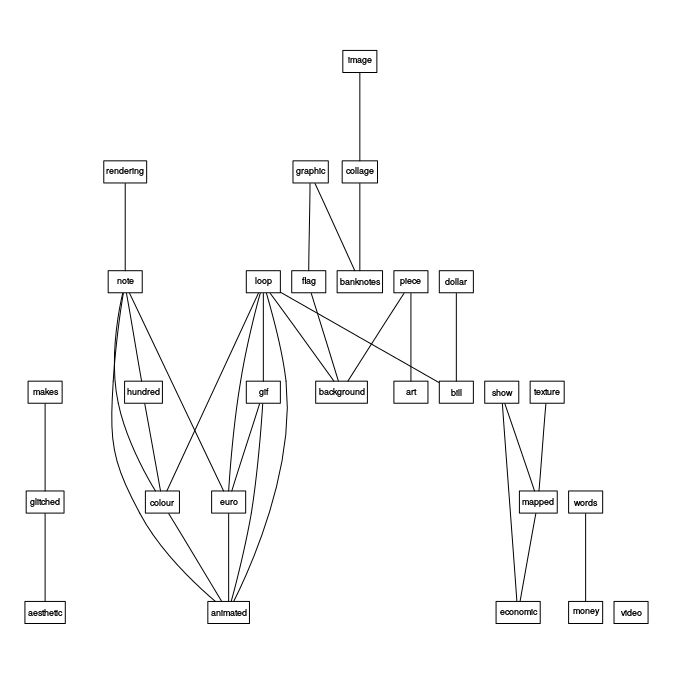
    The most popular subjects are dollar and Euro bills. Art about them shows something about them. It does so using video, animations (whether video, Flash, or HTML5), images, glitch and texture mapping.

    Terms I use five or more times:

     [1] "aesthetic"  "animated"   "art"        "background" "banknotes" 
     [6] "bill"       "collage"    "colour"     "dollar"     "economic"  
    [11] "euro"       "flag"       "gif"        "glitched"   "graphic"   
    [16] "hundred"    "image"      "loop"       "makes"      "mapped"    
    [21] "money"      "note"       "piece"      "rendering"  "show"      
    [26] "texture"    "video"      "words"
    

    Flags and words join the subjects, hundred unit notes are the most popular, looped animated GIFs, collages and graphics join the forms and figure/ground relations are there with mention of “background”.

    Finally let’s look at words I use three or more times:

     [1] "abstract"    "aesthetic"   "album"       "allow"       "american"   
     [6] "animated"    "apparently"  "application" "art"         "background" 
    [11] "banknotes"   "bill"        "black"       "blue"        "changing"   
    [16] "classic"     "collage"     "colour"      "composite"   "depicted"   
    [21] "direct"      "dollar"      "economic"    "effective"   "euro"       
    [26] "facebook"    "flag"        "flickering"  "frame"       "gif"        
    [31] "glitched"    "google"      "graphic"     "grid"        "html5"      
    [36] "hundred"     "image"       "landscape"   "like"        "link"       
    [41] "loop"        "love"        "makes"       "mapped"      "million"    
    [46] "money"       "monochrome"  "morphing"    "new"         "note"       
    [51] "one"         "page"        "patterns"    "piece"       "pixelart"   
    [56] "playing"     "polygons"    "possibly"    "price"       "rendering"  
    [61] "screen"      "show"        "signs"       "sites"       "stack"      
    [66] "style"       "texture"     "time"        "use"         "video"      
    [71] "virtual"     "web"         "white"       "words"       "work"       
    [76] "yellow"      "zoomed"
    

    No surprises there, except possibly “love”. The code will confuse “Euro” and “European”, so that’s why the US is mentioned but not Europe. Facebook and Google add corporations to the subjects. Colours are added to the formal properties: yellow, blue, white, black. Landscape joins the subjects. And works play, are direct, are classic, have style, an aesthetic, a price, are new. And I weasel about them with “possibly”.

    Next lets look at the associations between words. First some obvious ones.

    Money:

    google           love          1990s            age        ambient 
      0.65           0.59           0.43           0.43           0.43
    

    Art:

    corrupted     miscoloured         nothing          purest            rows 
         0.75            0.75            0.75            0.75            0.75 
       street            look            much           piece         classic 
         0.75            0.52            0.52            0.48            0.41 
    

    Net:

    carefully    contract   described        form        sale    specific 
         1.00        1.00        1.00        1.00        1.00        1.00 
      another application       price       piece         art 
         0.70        0.49        0.44        0.43        0.36
    

    The corruption found in association with art here is aesthetic, thanks to glitch art.

    The word cloud in the next section has some stand-out words. We can look at their associations as well to follow suggestions from within the data.

    Dollar:

    bill                         1950s 
    0.87                          0.33
    

    Video:

    vimeo     amateur      batter       beach     clipart   commodity 
     0.40        0.39        0.39        0.39        0.39        0.39
    

    Bill:

    dollar                         1950s 
      0.87                          0.38
    

    Videos are mostly on Vimeo. Dollar and bill occur together so there’s no surprises there.

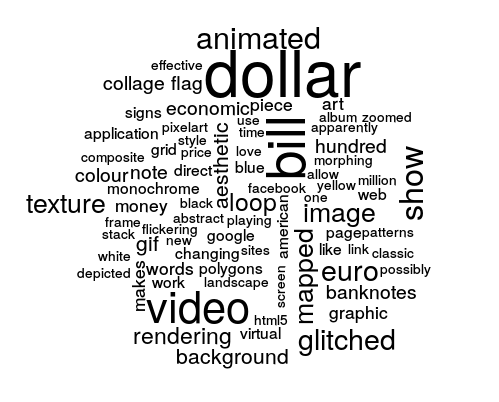
    Word clouds are a good way of quickly visualising word frequency. Here’s one of the words in the reviews:

    wordcloud

    Using the code from my old posts on Vasari’s Lives and on art bloggers we can find the most similar reviews:

    Dominik Podsiadly :  JUST DO IT, Jefta Hoekendijk 
    
    Maximilian Roganov :  Jasper Elings, Jefta Hoekendijk, Keigo Hara, Alfredo Salazar Caro | TMVRTX, Mathieu St-Pierre 
    
    JUST DO IT :  Jefta Hoekendijk, Dominik Podsiadly, Lars Hulst 
    
    Mitch Posada :  Dafna Ganani 
    
    Lorna Mills & Yoshi Sodeoka :  Jennifer Chan 
    Jasper Elings :  Maximilian Roganov, Curt Cloninger, Adam Braffman, Δεριζαματζορ Προμπλεμ Ιναυστραλια 
    
    Alfredo Salazar Caro | TMVRTX :  Nick Briz, Maximilian Roganov 
    
    Dafna Ganani :  Mitch Posada 
    
    Jennifer Chan :  Lorna Mills & Yoshi Sodeoka 
    
    Jefta Hoekendijk :  JUST DO IT, Maximilian Roganov, Lars Hulst, Dominik Podsiadly 
    
    Keigo Hara :  Maximilian Roganov, Nick Briz 
    
    Ellectra Radikal :  Lars Hulst 
    
    A Bill Miller :  Mathieu St-Pierre 
    
    Nicolas Sassoon :  Lars Hulst 
    
    Curt Cloninger :  Jasper Elings, Nick Briz 
    Δεριζαματζορ Προμπλεμ Ιναυστραλια :  Jasper Elings 
    Lars Hulst :  Ellectra Radikal, JUST DO IT, Jefta Hoekendijk, Nicolas Sassoon 
    
    Nick Briz :  Alfredo Salazar Caro | TMVRTX, Keigo Hara, Curt Cloninger 
    
    Adam Braffman :  Jasper Elings 
    
    Rollin Leonard :  Maximilian Roganov 
    
    Mathieu St-Pierre :  A Bill Miller, José Irion Neto, Maximilian Roganov 
    
    José Irion Neto :  Mathieu St-Pierre 
    

    Do those make sense to look at the art?

    The clustering code from the same old posts produces different groupings:

    Cluster 1 : Robert B. Lisek, Geraldine Juarez 
    
    Cluster 2 : Mitch Posada, Nick Kegeyan, Dafna Ganani, Marco Cadioli, Andrey Keske, Guayayo Coco 
    
    Cluster 3 : Rafaël Rozendaal, Adam Ferriss, Aaron Koblin + Takashi Kawashima, Maximilian Roganov, Fabien Zocco, Jasper Elings, Alfredo Salazar Caro | TMVRTX, Anthony Antonellis, Haydi Roket, Keigo Hara, A Bill Miller, Benjamin Berg, Δεριζαματζορ Προμπλεμ Ιναυστραλια, Nick Briz, Vince Mckelvie, Adam Braffman, Rollin Leonard, Mathieu St-Pierre 
    
    Cluster 4 : Dominik Podsiadly, Thomas Cheneseau 
    
    Cluster 5 : Ciro Múseres 
    
    Cluster 6 : Curt Cloninger 
    
    Cluster 7 : Miron Tee, Jan Robert Leegte, Paul Hertz, Jon Cates, León David Cobo, Kamilia Kard 
    
    Cluster 8 : Nuria Güell, Paolo Cirio, Filipe Matos, Agente Doble | UAFC, JUST DO IT, Gustavo Romano, Tom Galle, Cesar Escudero, Jefta Hoekendijk, Gusti Fink, Ellectra Radikal, Aoto Oouchi, Kim Laughton, Martin Kohout, Marc Stumpel, LaTurbo Avedon, Nicolas Sassoon, Erica Lapadat-Janzen, Milos Rajkovic, Rozita Fogelman, Lars Hulst, Yemima Fink, José Irion Neto 
    
    Cluster 9 : Emilio Vavarella 
    
    Cluster 10 : Dave Greber, Lorna Mills & Yoshi Sodeoka, Jennifer Chan, Frère Reinert, V5MT, Addie Wagenknecht, Systaime, Émilie Brout & Maxime Marion, Georges Jacotey
    

    I chose ten clusters arbitrarily. There’s some overlap looking at the two techniques.

    I wanted to try out Topic Modelling on the data but an algorithm for choosing the optimal number of topics simply returned the same number as there are documents. So I tried 8, 12 and 20.

    12 gave “nice” results:

         Topic 1    Topic 2       Topic 3    Topic 4      Topic 5        
    [1,] "video"    "mapped"      "price"    "bill"       "animated"     
    [2,] "bill"     "dollar"      "changing" "dollar"     "architectural"
    [3,] "dollar"   "texture"     "image"    "love"       "euro"         
    [4,] "direct"   "bill"        "show"     "artist"     "glitched"     
    [5,] "facebook" "virtual"     "allow"    "google"     "graphic"      
    [6,] "faster"   "polygons"    "also"     "money"      "money"        
    [7,] "page"     "constituent" "analysis" "monochrome" "zoomed"       
    [8,] "abstract" "exploding"   "another"  "pixelart"   "1990s"        
         Topic 6      Topic 7           Topic 8       Topic 9    Topic 10  
    [1,] "graphic"    "labels"          "dollar"      "dollar"   "texture" 
    [2,] "abstract"   "landscape"       "glitched"    "euro"     "blank"   
    [3,] "aesthetic"  "album"           "bill"        "note"     "blue"    
    [4,] "album"      "animated"        "video"       "animated" "classic" 
    [5,] "apparently" "appears"         "aesthetic"   "bill"     "economic"
    [6,] "banknotes"  "art"             "application" "image"    "essay"   
    [7,] "european"   "banknotecollage" "colour"      "loop"     "euro"    
    [8,] "flag"       "banknotes"       "economic"    "american" "show"    
         Topic 11     Topic 12  
    [1,] "bill"       "art"     
    [2,] "dollar"     "bill"    
    [3,] "video"      "depicted"
    [4,] "background" "dollar"  
    [5,] "flag"       "labour"  
    [6,] "loop"       "video"   
    [7,] "reactive"   "words"   
    [8,] "roughly"    "1950s"   
    

    The topics are clearer with more words, these are just the first few for each one. I think this is the closest to what I want in terms of discovering what I have written about, although as I say the choice is arbitrary (or at least aesthetic rather than statistical).

    Using more code from the Vasari/bloggers posts, we can plot the associations between words:

    plot

    Changing the parameters and outputting to PDF creates a more detailed and readable graph. It’s fun and inbetween topic modelling and frequency counts for usefulness.

    Finally let’s see how I feel about the art with sentiment analysis:

    neutral positive 
         66        3 
    

    I do try to find the positive in artworks but there was one that gave me an immediate and visceral negative reaction in the show (you can spot it if you look hard at the reviews). I’m surprised that there are fewer that count as positive. I “love” one of the pieces. Is it in the positive list?

    [1] "Martin Kohout" "Marc Stumpel"  "Ciro Múseres"
    

    It’s not. But one of the ones listed does mention “love”, so I don’t know what’s happened there. Sentiment analysis has improved greatly over the last few years, but apparently not in the library I was using.

    If I was going to use these techniques to help review art I’d write longer “bag of word” descriptions for each artwork, with fragments of text and individual words acting almost as tags or streams of consciousness, and I would then use topic modeling and clustering to help pull out themes. I’d prefer to use an algorithm to choose the number of topics, as I feel this is more intellectually defensible, but I like the results enough to use it without. I’m disappointed by the performance of the sentiment analysis library I used, next time I’ll try a different one.

    Will there be a next time? Yes, the next time I’m reviewing a group show with more than a few artists. Producing this report has been labour intensive, but I’ve a libary of code now and a better understanding of the issues. And I can automate report construction and revision using Knitr, which would allow me to mix Markdown text and R code without hacing to copy and reformat output.

  • Work In Progress: Tate Collection Data Movements

    Here’s a sneak peek at one of the visualizations from my analysis of the Tate Collection data. It’s a graph of Movements linked by their artists:

    tate-movements-sna-preview

    More to come soon…

  • Exploring the Tate Collection Metadata

    The Tate have released their collection metadata in an exemplary way here:

    https://github.com/tategallery/collection

    Let’s explore it using MongoDB, which you can find installation structions for here.

    First fetch and upload the JSON data:

    git clone https://github.com/tategallery/collection.git
    cd collection
    find artists -name *.json -exec perl -p -e 's/\n/ /' '{}' \; -exec echo \; | mongoimport --db tate --collection artists
    find artworks -name *.json -exec perl -p -e 's/\n/ /' '{}' \; -exec echo \; | mongoimport --db tate --collection artworks

    Then in the mongo shell we can explore the artists and artworks:

    ////////////////////////////////////////////////////////////////////////
    // Artists
    ////////////////////////////////////////////////////////////////////////
    
    // List artist movements
    
    db.artists.aggregate(
    {$unwind: "$movements"},
    {$project: {name: "$movements.name"}},
    {$group: {_id: "movements", items: {$addToSet: "$name"}}}
    )
    
    // List artist eras
    
    db.artists.aggregate(
    {$unwind: "$movements"},
    {$project: {name: "$movements.era.name"}},
    {$group: {_id: "movements", items: {$addToSet: "$name"}}}
    )
    
    // Find artists by movement
    
    db.artists.find({"movements.name":"Pop Art"})
    
    // Find artists by era
    
    db.artists.find({"movements.era.name":"20th century post-1945"})
    
    // Find artists by birth year
    
    db.artists.aggregate(
    {$group: {_id: "$birth.time.startYear", artists: {$addToSet: "$fc"}}}
    )
    
    // Find artists by death year
    
    db.artists.aggregate(
    {$group: {_id: "$death.time.startYear", artists: {$addToSet: "$fc"}}}
    )
    
    // count artists by gender
    
    db.artists.aggregate(
        {$group : {_id : "$gender" , number : {$sum : 1}}},
        {$sort : {number : -1}}
    )
    
    // Count artists by birthplace
    
    db.artists.aggregate(
        {$group : {_id : "$birth.place.name" , number : {$sum : 1}}},
        {$sort : {number : -1}}
    )
    
    ////////////////////////////////////////////////////////////////////////
    // Artworks
    ////////////////////////////////////////////////////////////////////////
    
    // List artwork subject categories
    
    db.artworks.aggregate(
    {$unwind: "$subjects.children"},
    {$unwind: "$subjects.children.children"},
    {$group: {_id: "categories",
               categories: {$addToSet: "$subjects.children.children.name"}}}
    )
    
    // List artwork subjects
    
    db.artworks.aggregate(
    {$unwind: "$subjects.children"},
    {$unwind: "$subjects.children.children"},
    {$unwind: "$subjects.children.children.children"},
    {$group: {_id: "subjects",
               subjects: {$addToSet: "$subjects.children.children.children.name"}}}
    )
    
    // List artwork categorys and subjects
    
    db.artworks.aggregate(
    {$unwind: "$subjects.children"},
    {$unwind: "$subjects.children.children"},
    {$unwind: "$subjects.children.children.children"},
    {$group: {_id: "category-subjects",
               subjects: {$addToSet: {category: "$subjects.children.children.name",
                           subject:"$subjects.children.children.children.name"}}}}
    )
    
    // List artwork movements
    
    db.artworks.aggregate(
    {$unwind: "$movements"},
    {$group: {_id: "artwork-movements",
               movements: {$addToSet: "$movements.name"}}}
    )
    
    // Find artwork by category/subject group
    
    db.artworks.find({"subjects.children.children.name":"UK counties"})
    
    // Find artwork by subcategory/subject
    
    db.artworks.find({"subjects.children.children.children.name":"beacon"})
    
    // Find artwork by artist name
    
    db.artworks.find({"contributors.fc":"Andy Warhol", "contributors.role":"artist"})
    
    // Find artwork by movement. Will exclude works with no movement.
    
    db.artworks.find({"movements.name":"Pre-Raphaelite"})
    
    // Find artworks without movements
    
    db.artworks.find({"movementCount":0})
    
    // Find artwork by date. Will exclude works with unknown date.
    
    db.artworks.find({"dateRange.startYear": {$gte: 1900, $lt: 1910}})
    
    // Find artworks without dates
    
    db.artworks.find({"dateRange":null})

    Exploring the data it becomes clear that the structure of the metadata is wonderfully regular but some of the content is less so. For example entries in the “artists” data may be attributions to movements rather than individuals, and both movements and individuals may have null gender. Locations in birth and death data can be a town or country name in any language, or a town and country separated by a comma. Not every artwork has a creation date, movements, or subjects.

    But this is standard for real-world data, and easy enough to regularise. The community can do this and submit a pull request. What’s important is that this is a high-quality metadata dataset from a world-class art institution. People are already starting to explore and visualise it. See here for a great example:

    http://www.shardcore.org/shardpress/index.php/2013/11/06/tate-data-explorer/

  • Importing Tate Collection Data Into MongoDB

    You have to feed records into Mongo one per line. Like this:

    find artists -name *.json -exec perl -p -e 's/\n/ /' '{}' \; -exec echo \; | mongoimport --db tate --collection artists
    find artworks -name *.json -exec perl -p -e 's/\n/ /' '{}' \; -exec echo \; | mongoimport --db tate --collection artworks
    
  • What Is An Artist (On Wikipedia)?

    Wikipedia is the free online encyclopedia. It features articles on many thousands of artists. In the paper “Art History on Wikipedia, a Macroscopic Observation”, Doron Goldfarb et al use the Getty Union List Of Artist Names, via the Virtual Internet Authority File, as a name authority to find artists on Wikipedia. This approach has the advantage of authority, ULAN is used as the name authority by many projects including the Europeana open metadata project. But it has the disadvantage of imposing an external concept of who an artist is onto Wikipedia. If a way could be found of identifying artists using the information contained in Wikipedia’s articles, this would mean that we can use Wikipedia’s own concept of what an artist is to identify artists on Wikipedia rather than using an external authority.

    What, then, is an artist on Wikipedia?

    It is not an article tagged with a category containing the word “Artist”, as that also includes singers and other recording or performing artist(e)s.

    It is not an article with an “Artist” InfoBox, as although that is specific to artists not every artist or artist group has one.

    If we use the concept “Visual Artist” rather than “Artist”, this excludes performance artists.

    The Wikipedia-derived “semantic web” database Freebase provides a performative definition of a “Visual Artist” on its wiki: anyone (or anything) who has made a work of visual art. But this definition isn’t used by the actual database, which classifies performance artists as artists.

    An article’s membership of the Category “Artists” (or a sub-category of it) cannot be used to identify artists. This Category includes articles about works about artists, Artisans, and Nineteenth Century Composers.

    The best approach I have found for identifying what I regard as artists is to use DBPedia, another Wikipedia-derived semantic web database, to find articles that are tagged with sub-categories of the Category “Artists” and to filter out categories that I don’t think belong. But this is not using Wikipedia’s concept of what an artist is.

    So I have edited Wikipedia in order to exclude those sub-categories of “Artists” that I don’t think belong, given Wikipedia’s own definitions of the terms used to describe each sub-category. If these edits are not removed, then articles tagged with sub-categories of “Artists” will be a good definition of what an artist is given my interpretation of Wikipedia’s terms.

    This isn’t a disinterested discovery of knowledge on my part though. In trying to identify knowledge I have had to intervene to create it in a system of knowledge where it is difficult for words to mean more than one thing or have more than one context. The former is postmodern, the latter modern. Wikipedia is a site of tension between these approaches, and this is reflected in its ontology, in both the computer science and the philosophical sense.

  • Exploring Art Data 24

    (This post uses new features from the R Cultural Analytics Library version 1.0.6 .)

    We can divide an image into sections, analyse the R, G and B values of each of those sections and plot the results.

    library(CulturalAnalytics)
    library(jpeg)
    library(vegan)
    ## http://blog.wolfram.com/2008/12/01/the-incredible-convenience-of-mathematica-image-processing/
    ## Load the image
    imgdir<-paste(system.file(package = "CulturalAnalytics"), "images", sep = "/")
    dirimgs<-paste(imgdir, dir(path = imgdir, pattern = ".jpg"), sep = "/")
    img<-readJPEG(dirimgs[1])
    ## Divide it into sections and get a table of the median RGB values
    sections<-divideImage(img, 8, 8)
    ## Get the median rgb values for each image
    rgbs<-sapply(sections, function(img){ coords(medianRgb(imageToRgb(img))) },
    USE.NAMES=FALSE)
    ## The list needs transposing so we have columns of r,g,b values
    rgbs<-t(rgbs)
    ## Give the columns useful names
    colnames(rgbs)<-c("r", "g", "b")
    ## Bubble Chart
    plot(rgbs[,"r"], rgbs[,"g"], type="n", xlim=c(0,1), ylim=c(0,1),
    main="Section Bubble Chart of \"Bonjour, Monsieur Corbet\"",
    sub="(size is blue)", xlab="Red", ylab="Green")
    images(rgbs[,"r"], rgbs[,"g"], sections, cex=rgbs[,"b"])


    courbet bubble graph

    This shows no areas of pure, saturated colour.

    Next we can cluster the sections of the image and show the resulting clusters.

    
    ## Cluster the tiles by colour
    ## http://stackoverflow.com/questions/9019632/how-to-create-a-cluster-plot-in-r
    ## 5 is arbitrary
    clusters<-kmeans(rgbs, 5)
    ## distance matrix
    rgbs.dists<-dist(rgbs)
    ## Multidimensional scaling
    cms<-cmdscale(rgbs.dists)
    ## Plot the clusters
    plot(cms, type="n", xlim=range(cms[,1]), ylim=range(cms[,2]),
    main="Section Clustering of \"Bonjour, Monsieur Corbet\"")
    groups<-levels(factor(clusters$cluster))
    images(cms[,1], cms[,2], sections, thumbnailWidth=20)
    ordispider(cms, factor(clusters$cluster), label=TRUE)
    ordihull(cms, factor(clusters$cluster), lty="dotted")
     
    courbet section clustering
    If the plots didn’t have helpful titles, would you be able to recognize the image?

    Despite the arbitrary number of clusters chosen the groupings make some visual sense. Improving on the number of clusters is left as an exercise for the reader.

  • Reproduction Fees

    Via The Jackdaw:

    The Yale Center for British Art, New Haven, has placed digital images of its collections online. So far, so familiar. What is extraordinary is that all the images have been made available for reproduction free of charge, in superb high-resolution format, with no restriction over use… Other institutions in the USA are now considering whether to follow. The British Museum is a major institution that had already taken the same step in the UK. Otherwise the outlook in Britain is depressingly outdated, with museums and galleries, as this journal has frequently pointed out, obstructing not only scholarship but also wider familitarity with their collections throught the imposition of restrictive conditions on use and punitive fees. What makes it worse, much worse, are the outrageous claims to ‘copyright’ that are attached to use of images, preposterously applied to the mechanical reproductions of original works of art long out of copyright. This loathsome practice must stop.

    Robin Simon, The British Art Journal